A diamond can look beautiful under showroom lighting and still leave you with questions.
Is the color grade accurate? Are there inclusions you cannot see? Do the proportions help the diamond sparkle, or are they simply adding weight where no one will notice?
That is where grading reports come in. GIA, AGS, and IGI are three names buyers often encounter, but their reports are not identical. Each has its own history, strengths, and place in the diamond market.
Before buying a certified diamond, it helps to understand what each report tells you—and what it cannot decide for you.
First, What Does “Certified” Really Mean?
Despite the common phrase, laboratories generally grade diamonds rather than “certify” that they are beautiful, valuable, or right for a specific buyer.
A grading report may document:
- Carat weight
- Color and clarity
- Measurements and proportions
- Polish and symmetry
- Fluorescence
- Treatments
- Natural or laboratory-grown origin
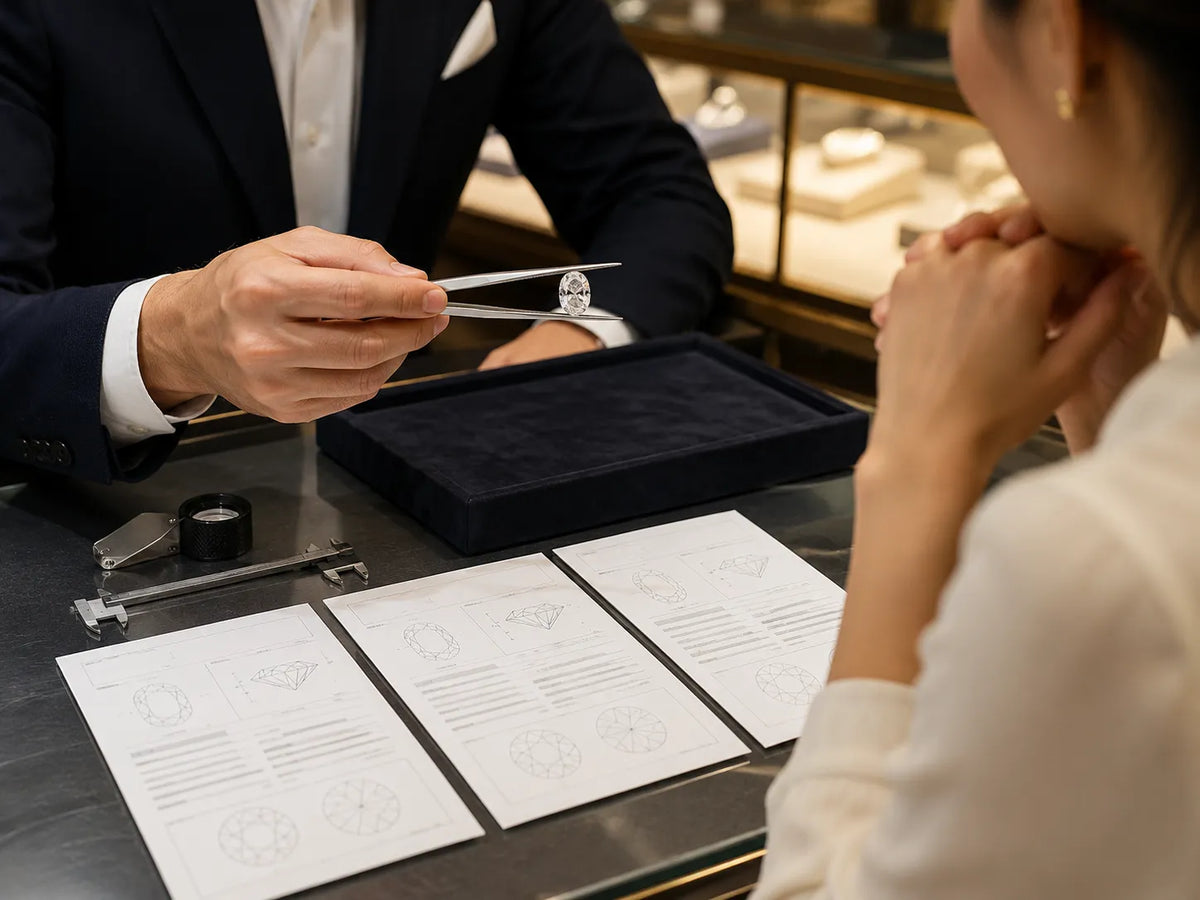
The report gives you a shared language for comparison. It does not replace seeing the diamond, examining how it handles light, or discussing its characteristics with an experienced jeweler.
Think of the report as the résumé. The diamond still has to interview well.
GIA: The Widely Recognized Benchmark
The Gemological Institute of America, better known as GIA, developed the modern 4Cs grading system and remains one of the most recognized names in diamond evaluation.
Its reports may include a full assessment of carat weight, color, clarity, measurements, polish, symmetry, fluorescence, and treatments. Depending on the report type, you may also see a plotted clarity diagram showing the location of inclusions.
Where GIA Is Especially Helpful
GIA reports are widely understood by jewelers, appraisers, insurers, and buyers. That recognition makes them especially useful when shopping for a natural diamond or comparing stones from different sellers.
Buyers can also verify report numbers through GIA’s online database. Before purchasing, confirm that the online record matches the paper report and, when applicable, the laser inscription on the diamond’s girdle.
What GIA Does Not Decide for You
A report may tell you that an oval diamond measures 10.2 by 7.1 millimeters. It will not tell you whether you personally like that shape.
GIA provides a cut grade for qualifying round brilliant diamonds, but fancy shapes require more interpretation. Two ovals with similar measurements can have very different outlines, bow-tie effects, and light performance.
The report should narrow your options, not make the final choice.
AGS: A Legacy Focused on Light Performance
The American Gem Society became especially well known for its research into cut quality and light performance. Older AGS Laboratory reports may still accompany diamonds already in the market, particularly precision-cut stones.
There is one important update: AGS Laboratories stopped issuing independent grading reports at the end of 2022, and its research and technology were integrated into GIA.
That does not make older AGS reports invalid. It simply means buyers should not expect newly issued standalone AGS grading reports in the same form.
Where the AGS Approach Still Appears
Eligible diamonds may now receive an AGS Ideal Report as a supplement to a GIA report. This additional document evaluates light performance, including brightness, fire, contrast, proportions, polish, and symmetry.
For buyers who care deeply about sparkle and precision cutting, that extra information can be valuable.
When an Older AGS Report Deserves Attention
An older AGS report may be useful when evaluating a diamond promoted for exceptional light return or highly precise cutting.
Check the report date, verify the diamond’s identity, and ask whether the stone has been repolished, damaged, or altered since the report was issued.
IGI: Common in Lab-Grown and Finished Jewelry
The International Gemological Institute, or IGI, grades natural diamonds, laboratory-grown diamonds, colored stones, and finished jewelry.
IGI reports are especially common in the lab-grown diamond market and among large retailers. They may include shape, measurements, carat weight, color, clarity, cut information, polish, symmetry, fluorescence, and treatment disclosures.
Where IGI Stands Out
IGI also provides reports for mounted jewelry. When a diamond cannot be fully examined because of its setting, some characteristics may be expressed as ranges rather than exact grades.
That flexibility can be useful for documenting an existing ring, although a loose stone can usually be evaluated more thoroughly.
Should You Avoid an IGI Diamond?
Not automatically.
A well-cut IGI-graded diamond can be more appealing than a poorly performing stone with another laboratory’s report. Consider the diamond, the price, the seller’s transparency, and the return policy—not just the letters on the document.
GIA vs. AGS vs. IGI at a Glance
Consider GIA when:
You want a widely recognized grading report, especially for a natural diamond, with clear 4Cs information and online verification.
Pay attention to AGS information when:
Cut precision and light performance are major priorities, particularly when a diamond has an older AGS report or a current AGS Ideal supplement.
Consider IGI when:
You are comparing lab-grown diamonds, mounted jewelry, or stones sold through retailers where IGI documentation is common.
No laboratory automatically produces the “best” diamond. Laboratories grade stones. They do not cut them.
The Oval Diamond Problem: Why Numbers Are Not Enough
Oval diamonds show why reports still require interpretation.
You can calculate the length-to-width ratio by dividing the length by the width. For example, an oval measuring 10.0 by 7.0 millimeters has a ratio of about 1.43.
An oval diamond ratio chart may describe certain ratios as rounded, classic, or elongated. These are preference guides, not universal quality grades.
The ratio also cannot fully reveal:
- The strength of the bow-tie effect
- The symmetry of the outline
- The shape of the ends
- How bright the center appears
- How large the stone looks face-up
Use an oval diamond ratio chart to understand the silhouette, then compare the actual diamonds in different lighting.
Does the Report Affect the Value of a Diamond?
The laboratory can influence buyer confidence, but it is only one factor affecting the value of diamond jewelry.
Value also depends on carat weight, cut, color, clarity, shape, origin, treatments, demand, and overall visual appeal.
A grading report is not the same as an appraisal. The report describes the stone. An appraisal estimates a monetary value for a specific purpose, such as insurance.
Two diamonds with similar grades can still have different prices because one has better light performance, a more appealing outline, or fewer visible inclusions.
Five Things to Check Before You Buy
- Verify the report through the laboratory’s official website.
- Confirm that the measurements and carat weight match the diamond.
- Read the comments and treatment disclosures.
- Ask where the inclusions are located and whether they are visible.
- Examine the diamond in more than one type of lighting.
The Best Report Still Needs the Right Conversation
GIA, AGS, and IGI each provide useful information, but buying a diamond should not feel like choosing which laboratory acronym wins.
The real goal is understanding what the document confirms—and where your own eyes and preferences need to take over.
At Statement Jewelers, we help clients interpret grading reports, compare proportions, evaluate visual performance, and understand how each detail affects beauty and price. Whether you are reviewing a natural or lab-grown certified diamond, studying an oval’s proportions, or considering the long-term value of diamond jewelry, our team can help you choose with confidence.