You’ve checked the carat weight, you like the color, the clarity looks good, and the cut is exactly what you wanted. Then, near the bottom of the grading report, you spot three words: “Fluorescence: Strong Blue.”
And suddenly the diamond you liked five seconds ago comes with a question mark. Should “strong” concern you? Will the diamond glow blue all the time? Does fluorescence make a diamond cloudy? Should you choose another stone?
Before you put the diamond back, there’s something worth knowing: diamond fluorescence is information about the stone, not an automatic warning about its quality.
You Probably Won’t Notice It Where You Think You Will
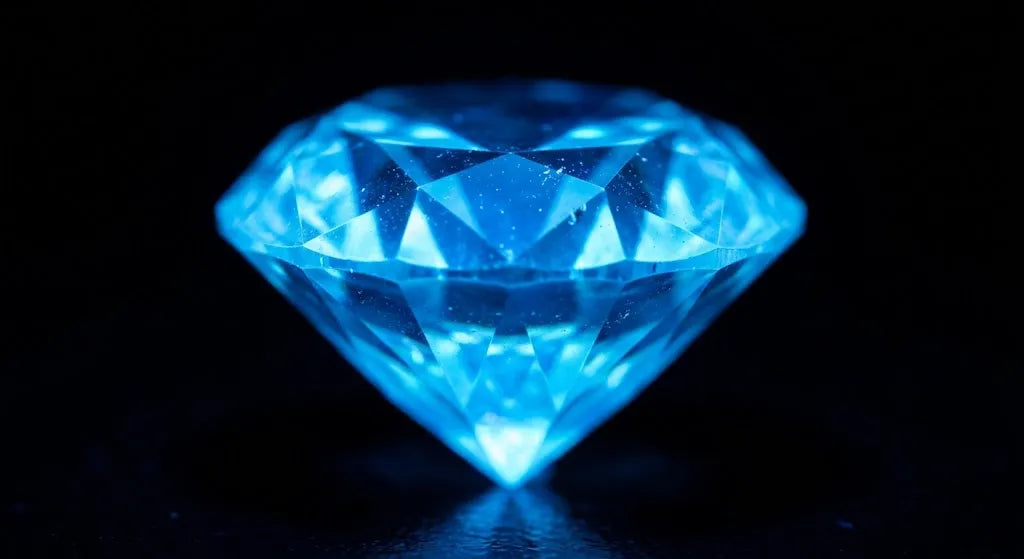
Despite the name, a fluorescent diamond doesn’t walk around glowing blue. Fluorescence describes the light some diamonds emit when exposed to ultraviolet (UV) radiation. Sunlight contains UV, as do black lights and some other light sources. Remove the UV source, and the fluorescent reaction stops.
Blue is by far the most common color. According to the Gemological Institute of America, roughly 25% to 35% of diamonds submitted to GIA show some degree of fluorescence, and more than 95% of those fluoresce blue. That makes fluorescence relatively common, even if the wording on a grading report can make it sound more dramatic than it is.
Why “Strong” Sounds Scarier Than It Is
“Strong” sounds like a judgment, but it isn’t. GIA describes fluorescence intensity as None, Faint, Medium, Strong, or Very Strong. A strong blue fluorescence diamond is simply one that produces a stronger fluorescent reaction under UV radiation.
That label alone doesn’t tell you whether the diamond is beautiful, cloudy, bright, or dull. So, is diamond fluorescence bad? Researchers have put that question to the test. In a GIA study of diamond fluorescence, observers evaluated diamonds under different lighting conditions to determine whether blue fluorescence affected appearance.
For the average observer, the study found no systematic relationship between fluorescence and transparency. In some viewing situations, strongly fluorescent diamonds were even perceived as having a better color appearance. That’s quite different from saying “strong fluorescence equals bad diamond.”
The Cloudy-Diamond Rumor Has a Grain of Truth
So where did fluorescence get its questionable reputation? Some diamonds with strong or very strong fluorescence can appear hazy or oily, but the key word there is some.
GIA has reported that this effect is rare, and later research found that light-scattering defects within a diamond can contribute to haziness independently of fluorescence. Strong fluorescence may make that appearance more noticeable in certain stones.
Translation: a hazy fluorescent diamond exists, but a strong blue fluorescence diamond isn’t automatically a hazy diamond. That distinction is exactly why rejecting a stone based on its grading report alone can mean ruling out a diamond you might have loved in person.
Here’s Where Things Get Weird: Blue Can Make a Diamond Look Whiter
Remember your elementary-school color wheel? Blue and yellow sit opposite each other.
That relationship can become interesting in diamonds with warmer body color. Under lighting that contains enough UV, blue fluorescence may visually offset some yellow coloration and make certain diamonds appear whiter. It’s not a permanent change to the diamond’s color grade, and the effect can change under lighting with little or no UV.
Still, it explains something that seems counterintuitive at first: fluorescence isn’t always a characteristic buyers want to avoid. In the right diamond, some people may actually like what it does.
And Yet, the Market May Still Care
Here’s the odd part: a diamond can look beautiful and still be priced differently because of fluorescence.
Market preferences have historically affected how some fluorescent diamonds are valued, particularly higher-color stones with Strong or Very Strong fluorescence. That means two diamonds with otherwise similar specifications may not carry identical prices, which can sometimes create an interesting buying opportunity.
Sometimes you’re paying for what a diamond looks like. Sometimes you’re also paying for what the market thinks about the words printed on its grading report. Neither should be considered in isolation.
So, Would We Reject a Diamond Because of Fluorescence?
No, not from the report alone.
We’d want to see the diamond, look at its transparency, notice how lively it appears, compare it under different lighting, and place it beside a diamond with similar specifications and little or no fluorescence. Then we’d look at the price difference.
If the fluorescent diamond appears clear, bright, and beautiful to you, the word “Strong” on the report may matter far less than you initially thought. That’s a more useful answer to “Is diamond fluorescence bad?” than any blanket yes or no.
Go Back to That Line on the Report
“Fluorescence: Strong Blue.”
It probably looks a little different now. Not good. Not bad. Information.
A grading report can tell you how strongly a diamond fluoresces. It can’t tell you whether you’ll prefer that diamond when it’s sitting in front of you. For that, you need to look up from the paperwork and see how the stone actually performs.
See Beyond the Diamond Report at Statement Jewelers
At Statement Jewelers, we can help you understand what fluorescence means for the specific diamond you’re considering, compare stones in person, and explain how characteristics on a grading report translate to what you actually see.
Because when you’re choosing a diamond, three words on a report shouldn’t make the decision for you.