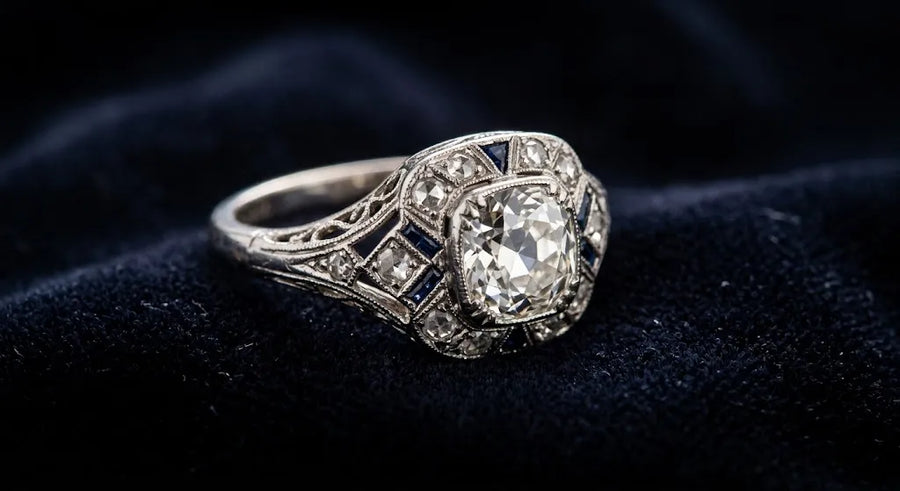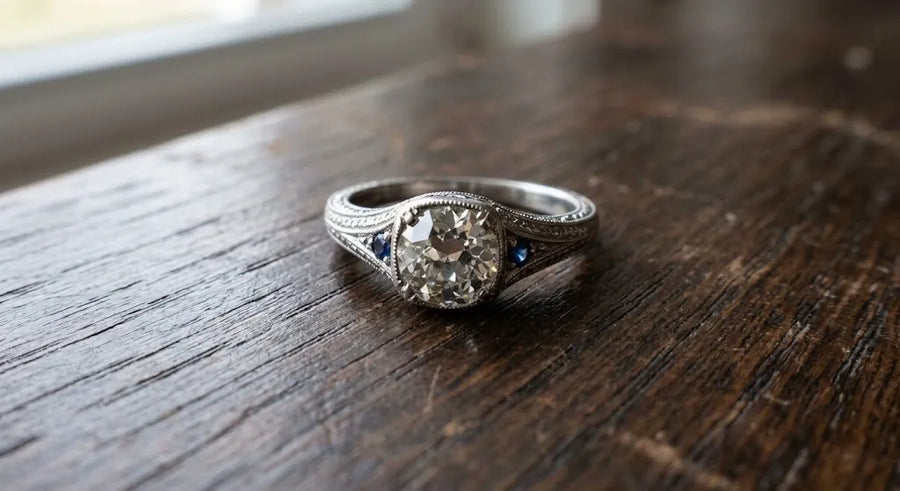
It sparkles like a diamond. It looks clear under a loupe. Maybe someone even told you it’s been in the family for decades.
So you should be able to figure out exactly what you’re looking at, right?
Not quite.
A natural diamond, a lab-grown diamond, and a treated natural diamond can all look beautiful on your hand. The differences between them aren’t always sitting there waiting for you to spot them.
And that’s where this gets interesting.
If you’re trying to learn how to tell if a diamond is lab grown, the first thing to know is that your eyes can give you clues. They can’t always give you the answer.
Clue No. 1: How It Looks Won’t Settle the Question
A lab-grown diamond isn’t a diamond imitation like cubic zirconia or moissanite.
It’s a diamond.
Lab-grown and natural diamonds are so similar chemically and optically that traditional observations and older diamond-testing devices can’t reliably separate them, according to the Gemological Institute of America.
That makes natural vs synthetic diamond identification a lot more complicated than looking for a visual giveaway.
A trained gemologist may spot characteristics that point in one direction, but even those clues sometimes need confirmation from specialized equipment.
So if someone claims they can always identify a lab-grown diamond by looking at it across the counter, keep asking questions.
Clue No. 2: The Inside of the Diamond Has Stories to Tell
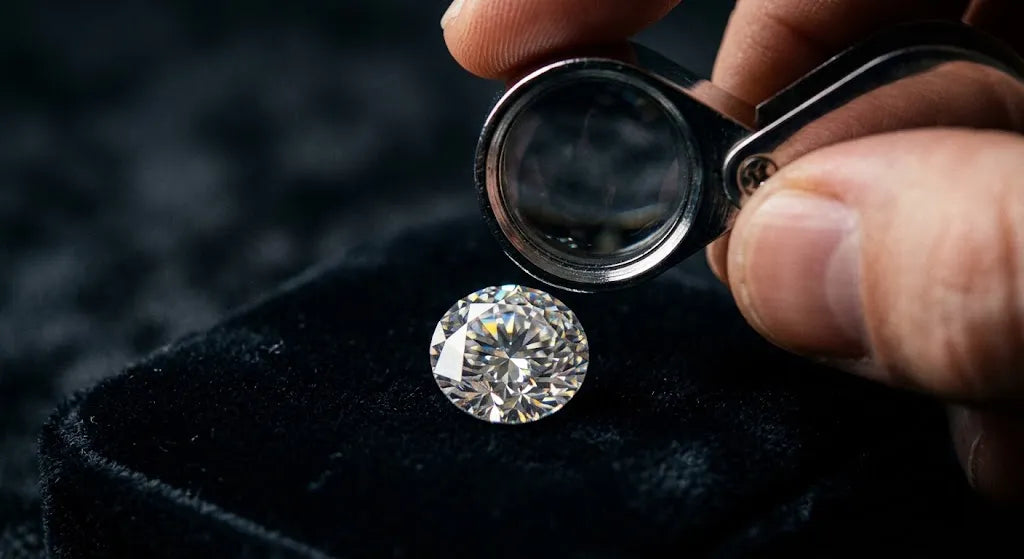
Now give the gemologist a loupe or microscope, and things get more interesting.
The conditions in which diamonds grow can leave behind different characteristics.
GIA researchers have found that some HPHT lab-grown diamonds contain metallic inclusions, while CVD-grown diamonds may contain dark pinpoint or graphitic inclusions. Growth patterns, graining, strain, fluorescence, and phosphorescence can provide additional clues.
But there’s a catch.
One inclusion isn’t a verdict.
As lab-grown diamond technology has advanced, identification has become more complex. A 2024 Gems & Gemology review notes that confirming lab-grown origin typically requires evaluating a combination of gemological characteristics rather than relying on one feature.
Think of inclusions as evidence, not a confession.
Clue No. 3: Check the Girdle
Before reaching for sophisticated equipment, there’s another place worth looking: the diamond’s girdle.
Many graded lab-grown diamonds carry a laser inscription identifying their laboratory-grown origin along with a report number. That inscription can connect the stone to its grading documentation.
Useful? Absolutely.
Enough on its own? Not always.
Not every diamond comes with the same documentation, and an inscription shouldn’t replace proper verification when origin is uncertain.
If there’s a grading report, check that its identifying information corresponds with the stone you’re examining.
Then read beyond the color and clarity grades.
Because there may be another detail hiding there.
Wait—There’s a Third Category
Most shoppers approach this as a two-answer question:
Natural or lab-grown?
But a diamond can be natural and treated.
Treated diamonds have undergone processes designed to alter characteristics such as color or clarity. Treatments can include HPHT processing, irradiation, laser drilling, coatings, and fracture filling.
And yes, the terminology gets confusing.
HPHT, for example, can describe a process used to grow a laboratory diamond or a process used to treat the color of an existing diamond.
That’s why knowing that a stone is natural doesn’t answer every question about it.
You also want to know whether its appearance has been altered.
Your Fog Test Isn’t Going to Solve This Mystery
The internet has plenty of home diamond tests.
Breathe on it. Drop it in water. Read through it. Inspect how it sparkles.
Those tricks might make for an entertaining afternoon, but they can’t reliably establish whether a diamond grew underground or in a laboratory—or whether a natural diamond has received certain treatments.
The reason comes back to what we already know: natural and lab-grown diamonds share many of the same fundamental properties.
Your breath may tell you whether a mirror is cold. It’s considerably less qualified to determine a diamond’s origin.
So How Does a Gemologist Actually Know?
This is where the mystery becomes science.
Professional laboratories can examine growth patterns, fluorescence behavior, trace elements, crystal defects, and other characteristics using specialized instruments.
Fluorescence can offer one clue. Research published by GIA in 2025 explains that natural diamonds that fluoresce tend to react more strongly to long-wave UV, while lab-grown diamonds often react more strongly to short-wave UV. Phosphorescence—a glow that continues after the UV source disappears—is also more commonly associated with certain lab-grown diamonds.
Still, one glowing diamond doesn’t solve the case.
Laboratories can combine fluorescence imaging with techniques such as absorption and photoluminescence spectroscopy to examine features related to how the crystal formed. That combination of evidence is what allows experts to reach a reliable identification. (GIA)
Before You Buy, Ask Four Questions
You don’t need a spectroscopy lab in your house. You need clear information.
Is the diamond natural or lab-grown?Get the origin stated clearly rather than assuming based on appearance or price.
Has the diamond been treated?If so, ask which treatment was used and whether it affects care, appearance, or value.
Does it have an independent grading report?Read the report rather than relying only on a verbal description.
Does the report match the stone?Check identifying information, including the report number and girdle inscription when applicable.
These questions are far more useful than trying to master natural vs synthetic diamond identification from online tricks.
The Real Clue Is Knowing Who Verified It
Go back to that diamond we started with.
It sparkles. It looks beautiful. And none of that tells you whether it’s natural, laboratory-grown, or one of the treated diamonds available in the market.
That information comes from evidence.
If you’re wondering how to tell if a diamond is lab grown, you don’t need to become the person operating the laboratory equipment. You need to know what documentation you’re looking at, what questions to ask, and who verified the answer.
Because the goal isn’t to solve a diamond mystery yourself.
It’s to know exactly what you’re buying.
Know Your Diamond at Statement Jewelers
At Statement Jewelers, we can help you understand your diamond’s documentation, explain what its grading information means, and answer questions about natural origin, lab-grown diamonds, and disclosed treatments.
Whether you’re buying a diamond or want to better understand one you already own, start with the facts behind the stone.